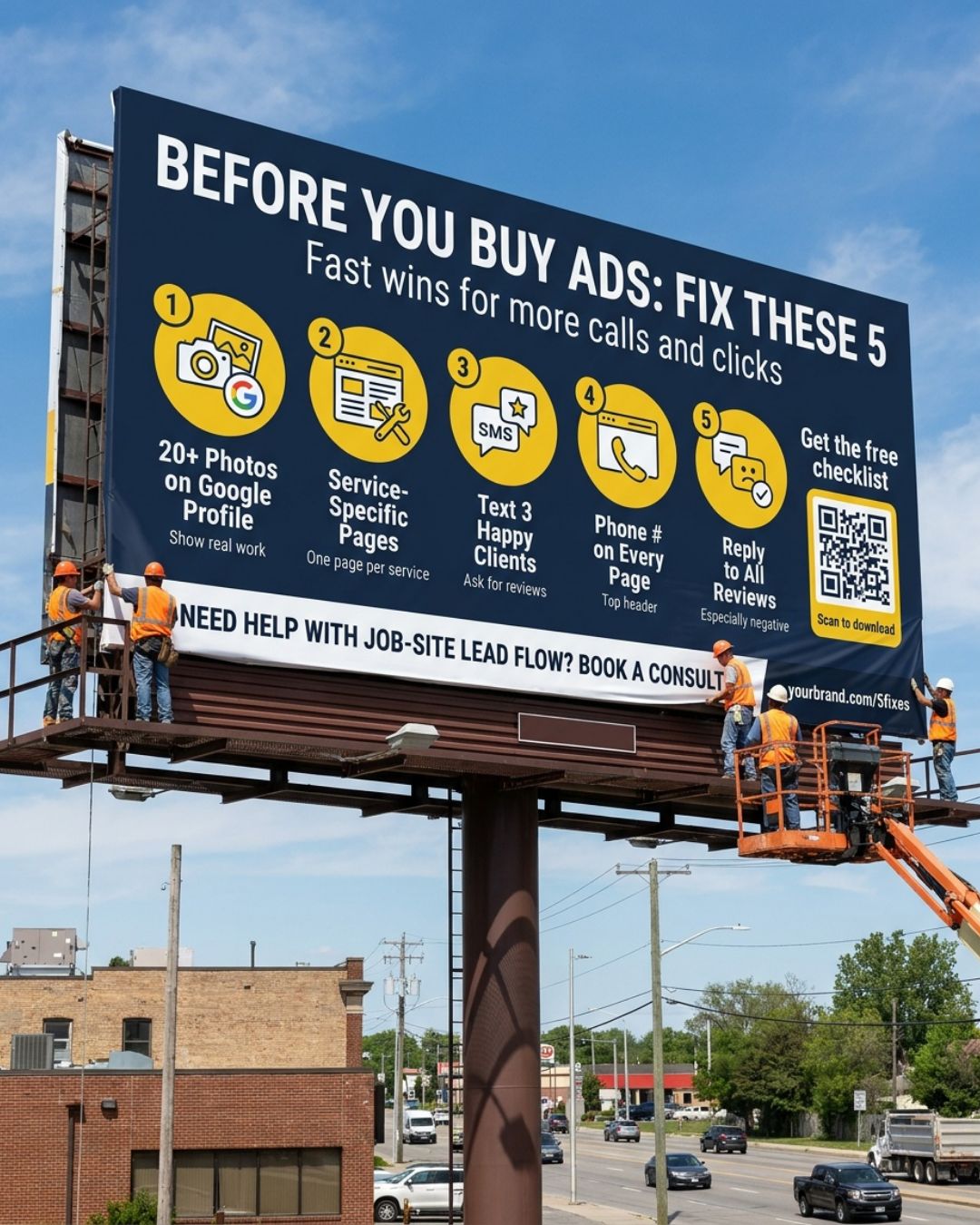
Before You Spend a Cent on Advertising: 3 Digital Essentials First
Before You Spend a Cent on Advertising: 3 Digital Essentials First
Before You Spend a Cent on Advertising: 3 Digital Essentials First
Before You Spend a Cent on Advertising: 3 Digital Essentials First
Why Contractors Lose Money on Advertising
The 3 Digital Essentials Every Contractor Needs Before Advertising
Essential 1: A Website That Converts, Not Just Exists
Essential 2: An Automated Follow-Up System
Essential 3: A Consistent, Trustworthy Digital Presence
What Happens When You Have All Three
The Cost of Skipping This Foundation
Introduction
Here's a conversation that happens more often than you'd think. A contractor spends R8,000 a month on Facebook or Google ads. People click. Traffic goes up. And then — almost nothing. A handful of enquiries that go cold, a few calls that lead nowhere, and a growing suspicion that "advertising just doesn't work for my business."
But here's what actually happened: the advertising worked. The problem wasn't the ad. The problem was everything that came after the click.
This is one of the most expensive mistakes service-based businesses make in South Africa — and it's almost entirely avoidable. Before you spend a single rand on paid advertising, there are three digital essentials that need to be in place. Without them, advertising doesn't amplify your business. It amplifies your problems.
In this article, we're going to walk through exactly what those three essentials are, why advertising fails without them, and what the real cost of skipping this foundation looks like in rand terms. By the end, you'll know exactly what to build first — and why getting this right gives you far greater returns than running ads on a broken system ever could.
Why Contractors Lose Money on Advertising
Let's start with the numbers. Facebook and Instagram advertising in South Africa typically costs between R50 and R300 per lead for home services and trades. Google Ads for contractor-related searches can run R12 to R65 per click — and in competitive categories like electrical, plumbing, and construction, clicks can reach R50 to R200 each.
Now run the maths. At a 3% landing page conversion rate — which is the industry average — a R10,000 monthly ad spend might generate approximately 500 clicks and 15 leads. If one in four leads becomes a paying client at an average job value of R15,000, that's a 5.6× return. Solid.
But here's what most contractors don't know: that 3% conversion rate assumes a fast, mobile-friendly, credible landing page with a clear offer and a functioning follow-up system. The average contractor website converts at under 1% — and many generate no leads at all, regardless of how much traffic is sent to them.
At 0.5% conversion, that same R10,000 ad spend produces just 2–3 leads per month. The economics collapse entirely.
This is why advertising "doesn't work" for most contractors. It's not the advertising. It's the infrastructure behind it.
Ready to see what a digital foundation looks like for your specific contracting business? Book a Demo with our team — we'll map out exactly what you need before you spend anything on ads.
The 3 Digital Essentials Every Contractor Needs Before Advertising
These three essentials form the foundation of your digital ecosystem. Each one makes advertising more effective. Together, they turn your digital presence into a lead-generating engine that would work even without paid ads — and that performs dramatically better when you add advertising on top.
Essential 1: A Website That Converts, Not Just Exists
Most contractor websites are built to exist. They describe the business, show some photos of past work, and have a contact page. That's it.
A website built to convert is a fundamentally different thing. It's designed around one primary goal: turning visitors into enquiries. Every page, every button, every headline is working towards that single outcome.
Here's what a converting contractor website includes:
Clear calls to action on every page. Not just a contact page — every page. A "Get a Free Quote" button in the header. A call-to-action mid-page. A form at the bottom. Multiple entry points for different levels of readiness.
A fast, mobile-first experience. 61% of online users are more likely to contact a business with a mobile-friendly website. In South Africa, where 77% of internet browsing happens on mobile devices, this isn't optional. A site that loads slowly on a phone or looks broken on a small screen is losing you leads every single day.
Real trust signals. Specific testimonials with names, suburbs, and job descriptions. Before-and-after photos. Registration and accreditation details. A professional photo of you and your team. Response time promises. Every one of these elements reduces the hesitation a potential client feels before reaching out.
A simple, low-friction quote form. Name, phone number, brief job description. Nothing more. Every additional field you add reduces completions. The goal is to make it as easy as possible to take the first step.
When advertising sends traffic to a site like this, the economics work. When advertising sends traffic to a static brochure site, the traffic evaporates.
Essential 2: An Automated Follow-Up System
You can have the best website in Johannesburg and still lose leads every single week. Not because the leads didn't enquire — but because nobody followed up fast enough.
Research consistently shows that responding to a lead within 5 minutes makes you significantly more likely to convert them than waiting an hour. But most contractors manually check email. They're on site, driving, managing a job. An enquiry comes in at 10pm on Tuesday. Nobody sees it until Wednesday morning. By then, the potential client has already called three other contractors.
An automated follow-up system changes this completely. The moment someone fills in your form or enquiries through your website:
They receive an immediate automated acknowledgement — a professional SMS or email confirming you've received their enquiry and setting expectations ("We'll be in touch within 2 hours")
You receive an instant notification on your phone with the lead's details
A follow-up message goes out automatically at 24 hours if the lead hasn't yet converted
A second follow-up at 48 hours keeps you visible without you lifting a finger
Businesses implementing automated follow-up systems see an average 42% increase in lead-to-appointment conversion rates within 90 days. Not by spending more on advertising — just by not letting leads go cold.
The maths is compelling. If you're spending R8,000 a month on advertising and losing 40% of your leads to slow response times, you're wasting R3,200 a month on traffic that enquiries and then disappears. An automated follow-up system costs a fraction of that — and recovers most of those lost leads.
This is the invisible lever most contractors are ignoring. And when you combine it with a converting website, the impact is immediate and measurable.
The CMART™ App includes automated follow-up built in — no separate software, no integrations, no technical setup. Sign up for your Free Trial today!
Essential 3: A Consistent, Trustworthy Digital Presence
The third essential isn't about technology. It's about credibility — and it's the one most contractors underestimate until they understand how modern client decision-making actually works.
Here's the reality: when someone clicks your ad, they rarely just fill in the form on your website. First, they Google your business name. They check your Google reviews. They look at your social media. They might visit your Facebook page. They're building a picture of who you are and whether they can trust you — usually within 2 to 3 minutes.
What they find in those 2 to 3 minutes either reinforces their interest or kills it entirely.
A consistent digital presence means:
A claimed and active Google Business Profile. Regularly updated, with real photos, accurate hours and contact details, and a steady flow of genuine reviews. Google rewards active profiles with better local search rankings. Potential clients use them to make the final trust decision.
Social media that shows your work. Not daily posting — just consistent. A few pieces of content per week that show your projects, your expertise, and the real people behind the business. When a client checks your Instagram and sees recent, professional content, they trust you more before the first conversation.
Recent, positive reviews. Reviews are the single most trusted form of social proof for service businesses. A contractor with 20 detailed Google reviews consistently out-converts a contractor with none — even when the second contractor does better work. After every completed job, asking for a review should be automatic. This is something a connected digital system can trigger for you.
A consistent phone number and address across all platforms. This sounds basic, but many contractor businesses have inconsistent contact information across their website, Google Business Profile, Facebook page, and directory listings. Google sees this as a trust signal — or a red flag. Consistency matters for both client trust and search visibility.
What Happens When You Have All Three
With a converting website, an automated follow-up system, and a consistent digital presence working together, something shifts. The leads don't just come in — they convert. Response times drop from hours to seconds. Trust is already established before the first phone call. The cost per acquired client falls as your conversion rates improve.
And here's the part that changes everything for advertising: when you add paid advertising on top of this foundation, the returns are dramatically different.
The same R10,000 ad spend that produced 2–3 leads per month on a basic website can produce 12–15 leads when it's sending traffic to a properly converting site with trust signals in place, and an automated system that responds within seconds. The advertising ROI jumps from neutral or negative to a genuine multiplier on your business.
This is the correct order of operations:
1. Build the foundation — converting website, automated follow-up, consistent digital presence
2. Test the system with organic traffic — social media, Google Business Profile, SEO content
3. Add paid advertising — now you're amplifying a system that already works
Most contractors do this backwards. They spend on advertising first, wonder why it isn't working, and never understand that the problem was never the advertising.
The Cost of Skipping This Foundation
Let's be direct about what skipping these three essentials actually costs.
If you spend R8,000 per month on advertising without a converting website, you might generate 2–3 leads at a cost of R2,600–R4,000 per lead.
With a converting website and follow-up system in place, the same budget generates 12–15 leads at a cost of R530–R670 per lead.
The difference is R2,000 per lead versus R600 per lead — for the same advertising budget.
Over 12 months, that gap compounds dramatically. A contractor who fixes their digital foundation before advertising can realistically generate 4–5 times more leads from the same spend. A contractor who doesn't is essentially paying premium prices for leads that mostly go cold anyway.
The foundation doesn't just make advertising work better. It makes your entire business more efficient. Enquiries that used to require manual follow-up happen automatically. Trust that used to require a long conversation is established before you even pick up the phone. Leads that used to slip through the cracks are captured and nurtured automatically.
Where the CMART™ Approach Starts
At Creative Media Agency, we work with contractors and service businesses across South Africa on exactly this sequence. Before we recommend any advertising spend, we make sure the three essentials are in place.
The CMART™ App is the platform that makes this achievable for a contractor without a marketing team or technical background. It combines a SMART website, CRM, automated follow-up, social media scheduling, and reporting into a single connected system — so all three essentials are running from day one.
This isn't about spending more. It's about making everything you already spend work harder.
Conclusion
The single biggest shift a contractor can make to their digital marketing isn't the ad creative, the platform choice, or the targeting. It's making sure the system behind the ad is ready to convert the traffic it receives.
The three digital essentials — a converting website, an automated follow-up system, and a consistent digital presence — are the foundation everything else is built on. Without them, advertising is expensive and unreliable. With them, advertising becomes a genuine multiplier on a system that already works.
If you're considering any advertising spend in the next 90 days, spend the first 30 days building this foundation. The return on that investment will outperform any ad campaign you could run on a broken system.
Ready to get started? Get a FREE SMART Website designed by our Team of Digital Architects today!
Frequently Asked Questions
Do I need all 3 essentials before I can start advertising? Ideally, yes — but you can start with the most impactful one first. A converting website is the most critical because advertising traffic lands there. If you have to prioritise, fix the website first, add automated follow-up second, and build your consistent presence third. Each step improves your advertising ROI meaningfully on its own.
How much does it cost to set up a proper digital foundation for a contractor in South Africa? The cost varies depending on the approach. A SMART contractor website with CRM and follow-up automation through the CMART™ App is available as a monthly subscription — making it accessible without large upfront costs. The investment typically recovers within the first 2–3 booked jobs from improved conversion rates.
How long does it take before the digital foundation produces results? The automated follow-up system works from day one — every enquiry gets an immediate response. Google Business Profile improvements take 4–8 weeks to show meaningful ranking improvements. A consistent social media presence builds trust over 3–6 months. The converting website's impact is measurable within the first 30 days of driving traffic to it.
My competitor is advertising heavily — should I match their spend? Not until your foundation is solid. An advertiser with a broken digital system is spending to compete on volume, which drives up costs for everyone. A contractor with a properly converting website and follow-up system will consistently outperform a higher spender on a poor foundation. Build the system first, then advertise strategically.
What's the biggest mistake contractors make with digital advertising? Running ads to a slow, mobile-unfriendly website with no follow-up system in place. The advertising drives traffic that doesn't convert, the contractor concludes that "advertising doesn't work," and stops before fixing the actual problem. The advertising wasn't the issue — the infrastructure behind it was.
